An Intuitive Example
Let us return to the story of John and his identical twin sisters Ann and Kelly. John has 1 kg of gold which he would like to divide between his two sisters.
We will consider two possible scenarios. In one, John loves both his sisters equally and hence is unbiased towards them; in another, John is a bit disappointed about Kelly’s foray into the fashion influencer world and hence loves Ann more than Kelly i.e., he is biased towards Ann.
Let us see how bias and advantage plays out in these two scenarios.
Let us first consider the case where John is unbiased.
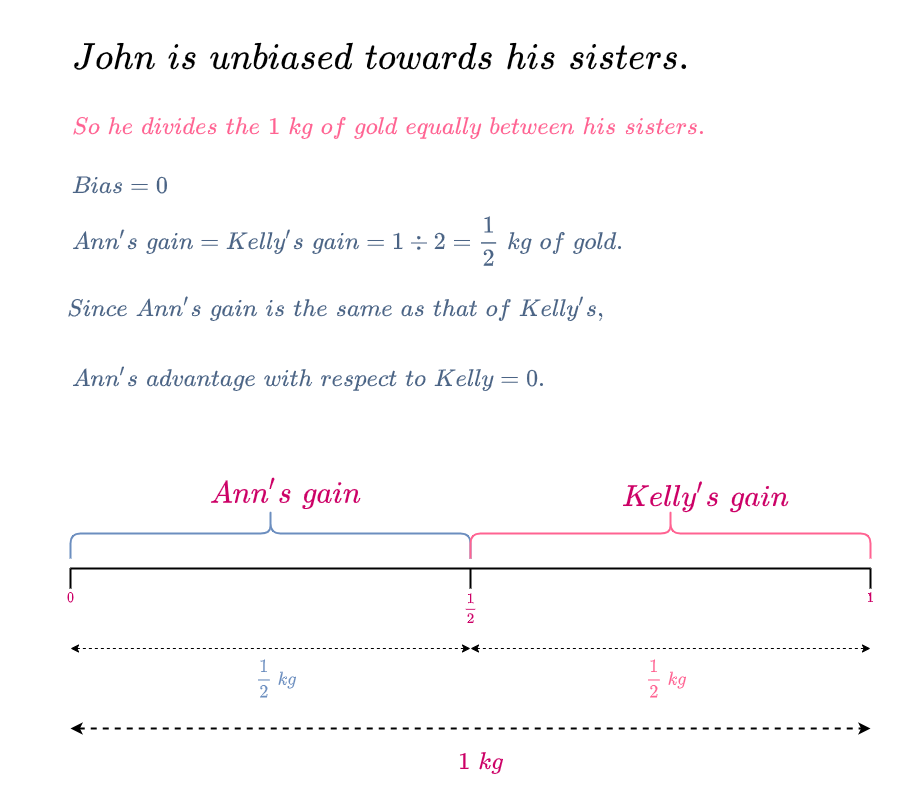
Since John is unbiased (i.e., bias = 0) , he divides the 1 kg of gold equally between his sisters. So each sister gets 1 \div 2 = \frac{1}{2} kg of gold. What is the advantage in being Ann rather than Kelly? Since both Ann’s gain and Kelly’s gain are the same (\frac{1}{2} kg of gold), there is no advantage in being Ann rather than Kelly. So the advantage of Ann with respect to Kelly = 0.
The following is a pictorially representation of the scenario when John is unbiased.
Now let us consider the case where John is biased towards Ann.
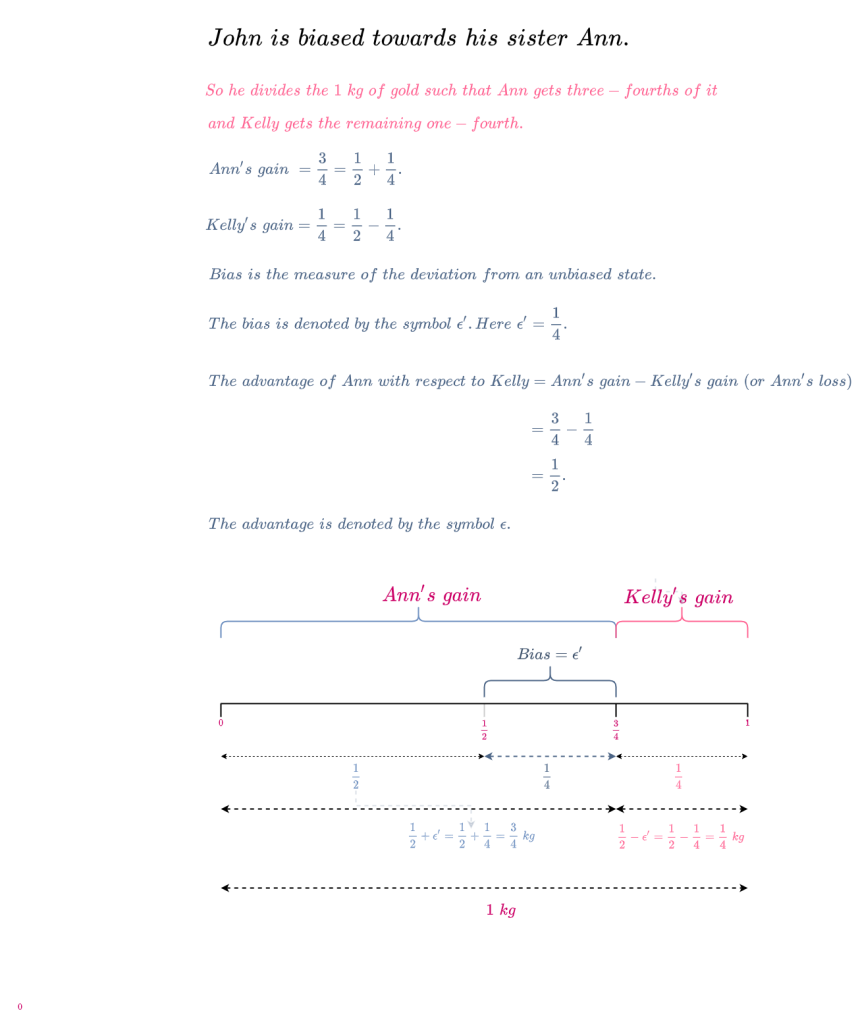
Since John loves Ann more than Kelly, he divides the 1 kg of gold such that Ann gets \frac{3}{4} kg of gold and Kelly gets the remaining \frac{1}{4} kg of gold. Due to John’s bias, Ann now gets \frac{1}{4} kg of more gold and Kelly gets \frac{1}{4} kg of less gold compared to John’s unbiased state, when they each got \frac{1}{2} kg of gold.
Bias is a measure of the deviation from the unbiased state (where the gold was divided equally between the two sisters).
Here, bias = \Big|\frac{3}{4} - \frac{1}{2}\Big| = \Big|\frac{1}{4} - \frac{1}{2}\Big| = \frac{1}{4}.
Ann’s gain = Unbiased Gain + bias = \frac{1}{2} + \frac{1}{4} = \frac{3}{4} kg.
Kelly’s gain = Unbiased Gain - bias = \frac{1}{2} - \frac{1}{4} = \frac{1}{4} kg.
Due to John favoring Ann over Kelly, Ann enjoys a positive bias of \frac{1}{4} and consequently, Kelly suffers from a negative bias of \frac{1}{4}.
The bias is denoted by the symbol \epsilon^\prime. Here \epsilon^\prime = \frac{1}{4}.
Is there an advantage of being Ann rather than Kelly? We can answer this question by finding out who is richer i.e., who gained more.
The advantage of Ann with respect to Kelly = Ann’s gain - Kelly’s gain = \frac{3}{4} - \frac{1}{4} = \frac{1}{2}.
Since Ann gained \frac{1}{2} kg more gold than Kelly, in this scenario there is a clear advantage in being Ann.
So we can define the advantage of one person with respect to another person in a game as the difference in gains between the two persons.
When Kelly gains \frac{1}{4} kg of gold, it is equivalent to Ann losing \frac{1}{4} kg of gold since she doesn’t get Kelly’s share. Had Kelly not been there, Ann would have got the entire 1 kg to gold. So missing out on the \frac{1}{4} kg of gold due to Kelly can be viewed as Ann’s loss.
Since when one person losses the other person gains we can also define advantage as follows.
The advantage of one person with respect to another person in a game can also we viewed as the difference between the gains and losses of the same person.
Using this definition,
The advantage of Ann with respect to Kelly = Ann’s Gain - Ann’s Loss = \frac{3}{4} - \frac{1}{4} = \frac{1}{2}.
We see that this agrees with our previous definition of advantage.
The advantage is denoted by the symbol \epsilon.
Here, \epsilon = \frac{1}{2} = 2 \times \frac{1}{4} = 2\epsilon^\prime.
We see that the advantage is twice the bias. Why is this so?
When Ann gains \frac{3}{4} kg of gold, her gain is equivalent to \Big(\frac{1}{2} + \frac{1}{4}\Big) kg of gold and her loss is 1 - \Big(\frac{1}{2} + \frac{1}{4}\Big) = \Big(\frac{1}{2} - \frac{1}{4}\Big) kg of gold.
Since advantage of Ann with respect to Kelly,
\begin{equation*}
\begin{split}
\epsilon & = \text{Ann's gain } - \text{Ann's loss (or Kelly's gain)} \\
& = \Big(\frac{1}{2} + \frac{1}{4}\Big) - \Big(\frac{1}{2} - \frac{1}{4}\Big) \\
& = \frac{1}{2} + \frac{1}{4} - \frac{1}{2} + \frac{1}{4} \\
& = \frac{2}{4} \\
& = 2 \times \frac{1}{4} \\
& = 2 \epsilon^\prime \\
\end{split}
\end{equation*}
Intuitively this makes sense because when one person’s gain is \frac{1}{2} + \epsilon^\prime then that person’s loss (or the other person’s gain) is 1 - \Big(\frac{1}{2} + \epsilon^\prime\Big) = \frac{1}{2} - \epsilon^\prime and so the advantage, \epsilon, which is defined as the difference between their respective gains becomes \Big(\frac{1}{2} + \epsilon^\prime\Big) - \Big(\frac{1}{2} -\epsilon^\prime\Big) = 2\epsilon^\prime .
The following is a pictorial representation of the case where John is biased.